
Translate (
en
)
- af
- sq
- am
- ar
- hy
- az
- eu
- be
- bn
- bs
- bg
- ca
- ceb
- zh-CN
- zh-TW
- co
- hr
- cs
- da
- nl
- en
- eo
- et
- fi
- fr
- fy
- gl
- ka
- de
- el
- gu
- ht
- ha
- haw
- iw
- hi
- hmm
- hu
- is
- ig
- id
- ga
- it
- ja
- jw
- kn
- kk
- km
- ko
- ku
- ky
- lo
- la
- lv
- lt
- lb
- mk
- mg
- ms
- ml
- mt
- mi
- mr
- mn
- my
- ne
- no
- ps
- fa
- pl
- pt
- pa
- ro
- ru
- sm
- gd
- sr
- st
- sn
- sd
- si
- sk
- sl
- so
- es
- su
- sw
- sv
- tl
- tg
- ta
- te
- th
- tr
- uk
- ur
- uz
- vi
- cy
- xh
- yi
- yo
- zu
News & Events
Quebec moves a step closer towards an equal school system
May 14, 2025
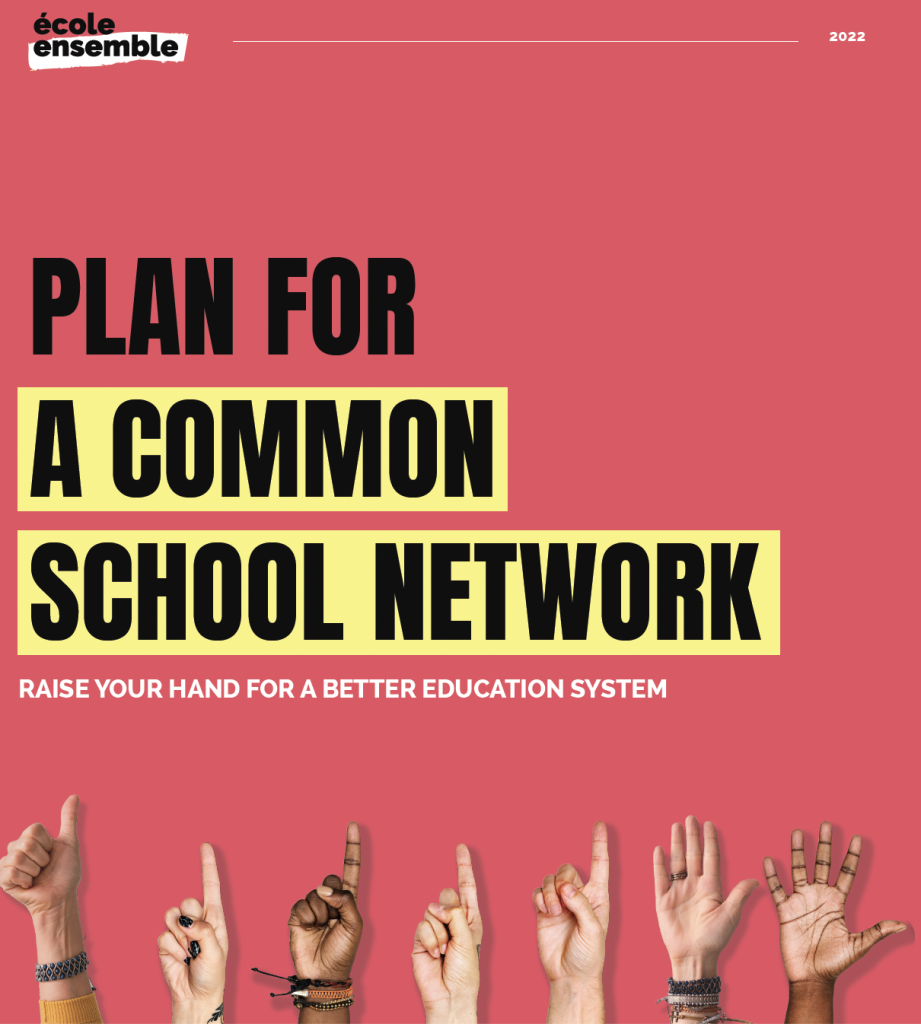
A Bill that would see public and private schools in Quebec become part of a free and accessible to all common network has been presented by Québec solidaire (QS) in the National Assembly of Quebec.
QS co-spokesperson Ruba Ghazal presented Bill 895 saying that it would ensure that all children in the province would have access to quality education, regardless of their parents’ income or their academic results.
The bill proposes to bring together public schools and private schools that agree to stop selection based on grades in particular, within a common network. Private schools that choose not to join this network would see their public funding cut. The legislation would also prohibit any process of student selection.
Bill 895 has been inspired by the plan for a common school network of the citizen group École ensemble presented in 2022. The Australian delegation to Canada in August 2024, supported by ALL and LEAP, met with Ecole Ensemble to find out more about its campaign for a common plan. Details of the meeting will be in Lessons from Canada due to be released in July 2025.
According to Ghazal, the Quebec school system is “three-speed”: the regular public, the public with special projects and the subsidized private. Students, she says, are sorted by their report card and their parents’ salary.
The three-speed school system is losing popular support in Quebec, according to the results of a CROP survey conducted for École ensemble and published Tuesday.
The proportion of respondents who believe publicly funded schools should not select students based on academic performance was 68 per cent in 2022, compared to 76 per cent in 2024, according to the poll
In 2016, the defunct Higher Council of Education stated in a report that Quebec schools were the most unequal in the country, an argument taken up by QS on Wednesday.
The mechanics of the National Assembly in Quebec means that while a bill must be “called” by the government for a vote to take place, it is rare for the government to authorize MPs to vote on an Opposition bill. Bill 895 will not become law immediately.
As Stéphane Vigneault, convenor of Ecole ensemble, says: “The Bill now exists, and it is no longer possible to ignore the plan for a common network. Quebec is one vote away from change.
More information about the common plan for Quebec is included in Towards an education system for the common good: desegregating Quebec’s schools in a market context for the Research Handbook on Education Privatization and Marketization.